
Did you know that only 3% of aspiring designers land top jobs in the industry? Success or failure often hinges on mastering key skills. Your path to success requires more than just creativity.
To be a top designer, you need both creative abilities and technical expertise. You must come up with new ideas and make them real with precision and market appeal. The industry looks for people who get both beauty and production, as well as what customers want.
Whether you learn on your own or through formal training, you must develop fashion design skills to succeed. Places like NIF Global Siliguri (contact: +91 98326 40060, nifsiliguri@gmail.com) have programs to help you get these skills.
This guide will show you the many skills needed to do well in today’s fashion world. You’ll learn how to grow as a creator who knows a lot about different areas.
Key Takeaways
- Success in the industry requires balancing artistic vision with commercial viability and technical proficiency
- Modern designers must be multidisciplinary professionals who understand manufacturing, markets, and consumer behavior
- Only 3% of aspiring designers reach established positions, making comprehensive skill development critical
- Structured training programs can accelerate your competency development across essential areas
- The marketplace demands professionals who can both conceptualize innovations and execute them with precision
- Your career trajectory depends on mastering a combination of creative, technical, and business abilities
Understanding the Fashion Industry
The fashion world is a complex web of players, trends, and history. It shapes every design choice you make. Getting quality education helps you understand this world, giving you a solid base for your career.
Knowing how different parts of the industry work is key. This knowledge helps you place your designs well and find chances that fit your vision. Designers who mix creativity with business skills and market knowledge do well.
Trends and Market Research
Spotting new fashion trends needs systematic research skills. You must analyze reports from agencies like WGSN and study consumer behavior. This industry analysis is crucial for making designs that sell.
Trade shows like Première Vision and Magic Las Vegas give insights into new textiles and styles. Going to these events helps you meet suppliers, see what competitors are doing, and find market gaps. Social media shows what people like and what’s trending fast.
When you compare yourself to others, look at both direct competitors and other market areas. See how brands like Reformation and Everlane won over customers with green messages. Look at their pricing, marketing, and how they stand out.

It’s important to know trends but also to be original. Just following trends makes your work unoriginal. The best designers mix new ideas with a fresh take on old ones.
Importance of Fashion History
Knowing fashion history is key for innovation and avoiding copying. Learning from designers like Coco Chanel and Yves Saint Laurent shows how new ideas come from understanding the past. This knowledge makes your designs richer and more informed.
Fashion goes in cycles, with old styles coming back. Knowing this helps you predict and update classic looks. The shift from Victorian to modern styles shows how society changes fashion.
Learning old techniques and patterns adds to your creativity. Victorian smocking and 1960s mod patterns can inspire modern designs. This knowledge lets you honor the past without making costumes.
Fashion is not just in clothes. It’s in the air, on the street; it’s about ideas and how we live. It’s about what’s happening.
Knowing history also helps you avoid cultural mistakes in your designs. Researching where styles and patterns come from shows respect for cultures. This approach builds trust with your audience.
Key Players in Fashion
The fashion world has many players who affect your career and designs. Luxury brands like Chanel and Gucci set high standards and focus on quality. They influence trends with runway shows and celebrity partnerships.
Fast-fashion brands like Zara and H&M have different business models. They focus on quick production and low prices. Knowing how they analyze trends helps you find opportunities or markets for your designs.
The supply chain includes textile makers, fabric suppliers, and production facilities. You need to know about fibers, weaving, and sustainable methods. Building good relationships with suppliers is key as you grow your business.
| Market Segment | Price Point | Production Timeline | Key Success Factors |
|---|---|---|---|
| Luxury Fashion | $500 – $5,000+ | 6-12 months | Craftsmanship, heritage, exclusivity |
| Contemporary | $100 – $500 | 3-6 months | Quality, trend relevance, brand story |
| Fast Fashion | $10 – $100 | 2-4 weeks | Speed, affordability, trend replication |
| Sustainable/Indie | $75 – $400 | 4-8 months | Ethics, uniqueness, community engagement |
Fashion journalists, bloggers, and influencers shape what people think and buy. Follow industry news from Vogue and Business of Fashion. Instagram and TikTok influencers can make or break designers.
Retailers and buyers decide what designs reach customers. Knowing their preferences helps you sell your work. Department stores and boutiques choose based on their customers and brand image.
Understanding the industry helps you place your work well and build a network. Each part of the fashion world offers chances and challenges. You must navigate these with knowledge and professionalism.
Creative Design Skills
Fashion design is built on three key skills that bring your ideas to life. These skills help you express your vision clearly. Through practice and learning, you develop the fashion design skills needed to create real collections.
Your creative skills are what make your work stand out. They help you stand out in a crowded market. To grow these skills, you must keep learning and trying new things.
Capturing Ideas Through Drawing
Being able to quickly sketch out ideas is crucial. Hand-drawn sketches catch ideas before they slip away. Even with new tech, pencil-on-paper sketching is still great for starting ideas.
Fashion illustration needs special skills. You must know how to draw fabric, garment details, and body shapes. These illustration techniques show how your designs will look on people.
Technical flat sketches are different from fashion illustrations. They give exact details for making clothes. They show the clothes from a simple view, without fancy drawings.
Fashion illustrations, on the other hand, show mood and style. They are used in marketing and portfolios. You can use pencils, markers, watercolors, or mixed media to express your style.
Finding the right tools for your style takes practice. Some like the precision of pens, while others prefer the flow of brush and ink. Your choice of tool is part of your unique style.
Understanding Color and Material Selection
Color theory is key for making designs look good. You need to know how colors work together and affect feelings. Color harmonies and contrast principles help you choose colors for your designs.
Seasonal colors reflect what’s in style and what people like. Spring is bright and light, while fall is deeper and richer. Your color choices should match your vision and what sells.
Different fabrics show colors in unique ways. Silk looks brighter than cotton in the same color. Knowing about fabrics is as important as knowing about colors.
Fabric properties like weight and texture change how clothes look. A design that looks great in silk might not work in stiff cotton. Your material selection decisions are crucial for bringing your vision to life.
Knowing what fibers are in fabrics helps you choose the right ones. Natural fibers like silk and wool are different from synthetic ones. Blends combine fibers for specific effects.
You need to know which fabric is right for each design. For example, silk is great for luxury, while cotton is better for structured clothes. Each choice affects how the garment looks, feels, and works.
Leveraging Technology for Design Development
Knowing how to use digital tools is key for modern fashion design. Design software speeds up your work and helps you communicate with others. Being good with these tools makes you competitive in today’s tech-driven fashion world.
Adobe Illustrator is the main tool for making technical flats and presentation boards. It lets you create detailed designs that don’t lose quality when scaled. You can make whole collections with precise details.
Adobe Photoshop is used for making designs look real and creating patterns. Its raster-based features let you create realistic textures and mood boards. Together, these programs are the base of digital fashion design.
Special 3D design software has changed how designers see their designs. Programs like CLO 3D and Browzwear let you see how clothes fit and move on digital models. This helps before making physical samples.
Learning design software takes time and practice. It’s worth it for faster design work and professional-looking portfolios. Now, manufacturers often want digital tech packs instead of hand-drawn ones.
| Design Software | Primary Function | Key Benefits | Industry Application |
|---|---|---|---|
| Adobe Illustrator | Technical flat creation | Scalable vector graphics, precise measurements | Tech packs, presentation boards |
| Adobe Photoshop | Rendering and textile design | Realistic textures, print patterns, mood boards | Fabric development, marketing materials |
| CLO 3D | 3D garment visualization | Virtual fitting, reduced sampling costs | Pre-production development, online retail |
| Browzwear | Digital prototyping | Accurate drape simulation, fit analysis | Sample reduction, sustainability initiatives |
Your digital skills help you work with manufacturers worldwide. Tech packs in standard formats ensure clear communication. This reduces mistakes and saves money.
Now, portfolios need to be digital as well as traditional. Employers and clients want to see your digital skills. Your technical skills are as important as your creativity in getting jobs.
Technical Skills for Fashion Design
Technical skills are key to bringing fashion designs to life. While creativity shows what a garment could look like, technical skills make it real. These skills turn two-dimensional sketches into three-dimensional clothes that people can wear.
Success in garment design comes from mastering practical skills. You need to know how fabric works, how patterns turn measurements into shapes, and how different construction methods affect the final product. This knowledge is what sets designers apart, making their designs wearable and manufacturable.
Building these skills takes practice and learning. You need to develop both knowledge and physical muscle memory through hands-on work. The mix of theory and practice is what makes a designer professional.
Creating Patterns and Manipulating Fabric
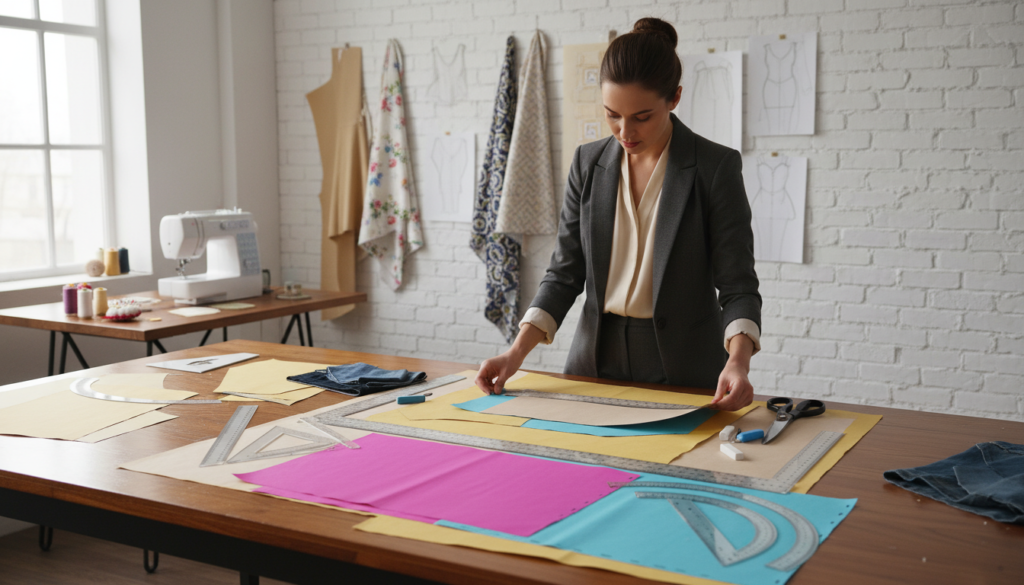
Pattern making is a fundamental skill for designers. It involves creating templates for cutting and assembling garments. You can use flat pattern making or draping, each with its own benefits.
Flat pattern making uses math and geometry to draft patterns. You start with basic blocks, which are foundation patterns for bodices, skirts, sleeves, and pants. These blocks are the basic shapes that fit the body without style details.
From these basics, you add darts, seam allowances, and style lines to achieve your design. Dart manipulation lets you change the silhouette while keeping the fit right. You need to understand how fabric grain, body curves, and design aesthetics work together.
Draping is a sculptural way to make patterns. You work with fabric on a dress form, pinning and shaping it to create three-dimensional forms. This method gives you quick feedback and allows for organic, flowing designs that might be hard to draft geometrically.
Your draping skills help you see how fabrics behave on the body. Lightweight fabrics create soft gathers, while structured fabrics hold sharp lines. This hands-on approach connects you with your materials and helps you understand fabric properties.
Both pattern making methods need practice and improvement. You must know how your creative choices affect fabric use, production efficiency, and manufacturing feasibility. This knowledge is crucial for turning design concepts into practical garments.
Mastering Construction Methods
Your sewing skills impact your ability to work with production teams and solve construction problems. Even if you don’t sew every garment, knowing construction techniques is absolutely essential. This knowledge lets you specify the right methods for different fabrics and designs.
Hand-sewing is key for couture finishing and delicate details. You should know how to do slip stitches, catch stitches, and pad stitching for tailored garments. These methods create invisible seams, secure linings, and attach embellishments without visible stitching.
Machine sewing is efficient for production and structural seams. You need to know different seam types and their uses:
- Plain seams for standard construction with most fabric weights
- French seams for sheer fabrics requiring enclosed raw edges
- Flat-felled seams for durability in sportswear and denim
- Lapped seams for decorative topstitching effects
Finishing techniques prevent fraying and make garment interiors look professional. Serging encloses raw edges with overlocking stitches, while bias binding wraps edges with fabric strips. Hong Kong finishes use lightweight fabric strips to encase seam allowances, creating beautiful interiors for unlined garments.
Specialized processes like inserting invisible zippers, creating bound buttonholes, and applying piping require specific technical knowledge. Your familiarity with these techniques lets you design details that can be made. Knowing the complexity and time needed for different methods helps balance creativity with production realities.
Different fabrics need different handling during construction. Slippery silks require careful pinning and slower sewing speeds. Heavy woolens need the right needle sizes and thread weights. Stretch knits need special stitches that allow for fabric movement. Your construction knowledge ensures you use the right methods for each material.
Ensuring Proper Fit and Structure
Understanding how garments fit the body is the peak of your technical skills. You need to know body proportions, size variations, and how construction techniques affect appearance and comfort. This knowledge makes sure your designs work well when worn by real people.
Ease allowances are how much extra room a garment should have. Close-fitting garments like bodycon dresses need little ease, while relaxed styles need more. You calculate ease based on fit, fabric, and comfort needs. Proper ease calculations prevent garments from being too tight or too loose.
Fitting sessions show how your patterns work on real bodies. You fit on dress forms or live models to find adjustments. Common fit problems include pulling across the bust, gaping at the neckline, or wrinkles indicating excess or insufficient fabric. Your technical skills let you fix these issues and adjust patterns.
Grading makes your patterns fit across different sizes while keeping design proportions. This process increases or decreases pattern pieces systematically, ensuring consistent fit across sizes. You need to understand which measurements change between sizes and how much adjustment each area needs. Proper grading makes your designs fit diverse body types.
| Technical Skill | Primary Application | Impact on Design | Learning Time |
|---|---|---|---|
| Flat Pattern Making | Creating precise geometric patterns from measurements | Enables technical accuracy and production efficiency | 6-12 months for proficiency |
| Draping | Developing organic shapes through fabric manipulation | Allows sculptural designs and immediate visual feedback | 8-15 months for mastery |
| Construction Techniques | Assembling garment components with appropriate methods | Determines garment durability and professional finish | 12-24 months for comprehensive knowledge |
| Fit Analysis | Ensuring garments conform properly to body shapes | Creates comfortable, flattering clothing across sizes | Ongoing refinement throughout career |
Internal garment structure greatly affects how it looks and feels. Interfacing stabilizes areas like collars and cuffs, preventing stretching. Underlining adds body to lightweight fabrics, while lining conceals construction and improves comfort.
Your knowledge of these structural elements lets you choose the right support for different designs. Tailored jackets need a lot of interfacing and precise construction. Evening gowns require strategic boning and inner construction. Casual knit garments need minimal structure to keep their relaxed drape.
These technical skills ensure your designs are not just pretty but also functional, comfortable, and manufacturable at scale. Your technical skills turn artistic vision into professional garment design that succeeds in the competitive fashion industry. Mastering these skills takes dedication, but they are essential for a successful fashion designer.
Business Acumen in Fashion
Your skills in creativity and technology are key to starting your career. But, knowing how to run a business is what keeps you going. Schools like NIF Global Siliguri teach both sides of fashion design. They help you get ready for the real world.
Marketing Strategies for Designers
You must show your work in the right way to attract customers. Know who you’re selling to and share your ideas through various channels. Social media sites like Instagram and TikTok are great for building your brand.
Even if you work for someone else, knowing marketing helps. You’ll learn to make designs that sell well. This includes using digital tools, working with influencers, and selling online.
Financial Management
Starting your own fashion business means you need to know about money. You’ll learn to plan budgets, set prices, and figure out costs. It’s also important to understand different pricing methods and manage your cash flow.
Good financial skills help you make smart choices about how much to make, who to buy from, and how much profit you want. Whether you start your own label or work for someone else, combining creativity with business smarts is what the fashion world looks for. These skills help you build a lasting, successful career in fashion.