
Did you know that creative professionals in India can see their earnings jump by 300% within just five years of entering the workforce? This dramatic growth potential makes understanding compensation trends essential before you invest time and money into your education.
Your career planning starts with knowing what you can realistically earn. The design profession offers exciting creative opportunities, but financial viability matters just as much as artistic passion.
Before you commit to expensive courses or specific specializations, you need clear answers. Can you build a sustainable career? What factors influence your earning potential? How do Indian market rates compare globally?
This guide gives you those answers. You’ll discover how location, experience, and specialization intersect to shape your financial future. Understanding these dynamics now helps you make strategic decisions about education, skill development, and career moves that maximize both creative fulfillment and financial success.
Key Takeaways
- Interior designer salary India varies significantly based on experience level, geographic location, and specialization area
- Understanding compensation trends before educational investment helps you make informed career decisions
- Multiple factors influence earning potential including portfolio quality, client base, and industry sector
- Strategic career planning in early stages can accelerate your path to higher pay scales
- Indian market rates show substantial growth potential for skilled professionals in the design field
- Location choice significantly impacts starting compensation and long-term financial prospects
Overview of Interior Designer Salaries in India
Your salary as an interior designer in India depends on many things. It’s not just about your education or talent. The interior designer salary India market is complex, influenced by local economies, demand, and your job status. Knowing these factors helps you make smart career choices and set realistic financial goals.
The design industry in India has grown a lot in the last ten years. This growth has opened up many opportunities in different areas like homes, offices, hotels, and shops. Your income will change a lot based on where you work and what you specialize in.
Salary Variations Across Major Indian Cities
Where you live is very important for your salary. Big cities like Mumbai and Delhi pay more, but living costs are also higher.
Bangalore is a competitive place for designers, with lots of work in offices and tech spaces. Hyderabad is also growing, with more luxury homes needing designers. Smaller cities like Pune, Ahmedabad, and Chandigarh are catching up as more homes and offices are built.
| City | Entry-Level Salary (Annual) | Mid-Level Salary (Annual) | Senior-Level Salary (Annual) |
|---|---|---|---|
| Mumbai | ₹3.5-4.5 lakhs | ₹6-10 lakhs | ₹12-25 lakhs |
| Delhi/NCR | ₹3.2-4.2 lakhs | ₹5.5-9 lakhs | ₹11-22 lakhs |
| Bangalore | ₹3-4 lakhs | ₹5-8.5 lakhs | ₹10-20 lakhs |
| Tier-2 Cities | ₹2.5-3.5 lakhs | ₹4-6.5 lakhs | ₹8-15 lakhs |
Salary differences between cities are real. They show the local cost of living, client budgets, and project complexity. For example, a designer in a smaller city might have more money to spend than one in Mumbai, due to housing and lifestyle costs.
Key Elements That Determine Your Earnings
Your design career salary is shaped by many factors. The size and reputation of your employer play a big role. Big firms with a national or international presence usually offer better salaries and benefits than small studios.
The health of your local economy affects project budgets and client spending. Cities with lots of luxury homes and offices can pay designers more. Your area of specialization also matters a lot. Designers for hospitality and commercial projects often earn more than those working on homes.
Who your clients are also matters. Working with wealthy clients can lead to high-budget projects and better pay. Your portfolio shows your skills and affects the rates you can charge.
Networking is also key to your salary. Good connections can lead to more opportunities and client referrals. Being able to clearly explain your designs is valued by clients and can increase your earnings.
Knowing how to use industry-standard software can make you more efficient and marketable. Designers skilled in AutoCAD, SketchUp, 3ds Max, and rendering software usually earn more. Your ability to manage projects, meet deadlines, and work with clients also adds to your value.
Understanding these factors helps you make smart choices about your career. Focus on improving your skills, finding the right niche, building your network, and creating a strong portfolio. These are the things you can control as you start your career.
Entry-Level Salaries for Fresh Graduates
Starting a career in interior design means knowing what you’ll earn first. Your salary as a new graduate depends on many things, not just your degree. Your first job offer will show how well-rounded you are, including your education, skills, and where you want to work.
In India, entry-level jobs pay between INR 2.5 lakhs and INR 4.5 lakhs a year. This range is wide, and knowing where you’ll fall in it helps you negotiate better. Your starting salary will depend on your qualifications and skills that make you valuable right away.
Where you studied is key to your first salary. Graduates from well-known schools often get higher starting pay. This is because employers trust the quality of education from these places. This can mean a 20-25% higher salary compared to graduates from less known schools.

What Junior Designer Roles Actually Pay
Knowing what junior designer jobs involve helps you judge salary offers. In your first job, you’ll work under supervision and focus on specific parts of projects. You’ll learn a lot, but you won’t lead the design yet.
Junior designers do tasks like making detailed drawings, picking materials, and helping with client meetings. These tasks help you grow professionally and add value to your employer’s work. Your salary reflects your current role and your potential for growth.
In big cities like Mumbai, Delhi, and Bangalore, junior designers earn more. But in smaller cities, salaries are lower. Still, the salary-to-expenses ratio is often similar everywhere.
Understanding market standards for your experience level is key. Many new graduates start at INR 2.5-3 lakhs a year, mainly in smaller cities or with small firms. But, those with strong portfolios and experience in big cities can earn INR 4-4.5 lakhs or more.
| City Category | Typical Starting Range (Annual) | Common First-Year Responsibilities |
|---|---|---|
| Metro Cities | INR 3.5-4.5 lakhs | CAD drafting, material sourcing, client meeting assistance |
| Tier-2 Cities | INR 3-3.8 lakhs | 3D modeling, vendor coordination, site visits |
| Smaller Cities | INR 2.5-3.2 lakhs | Design documentation, project support, basic rendering |
Skills That Command Higher Starting Compensation
Being tech-savvy is crucial for your salary from the start. Employers want you to be able to start working right away without needing to learn new software. Knowing tools like AutoCAD, SketchUp, and 3ds Max can increase your starting salary by 15-20%.
But, it’s not just about software skills. You need a balanced skill set that includes technical, creative, and people skills. Employers look for graduates who can handle all aspects of junior designer jobs, from technical work to talking with clients.
Key technical skills that boost your starting salary include:
- Advanced proficiency in AutoCAD for detailed construction drawings and floor plans
- 3D visualization skills using SketchUp, 3ds Max, or similar rendering software
- Knowledge of building codes, regulations, and compliance requirements
- Understanding of sustainable design principles and green building practices
- Familiarity with project management fundamentals and timeline coordination
Soft skills also set you apart. Skills like good communication, teamwork, time management, and problem-solving are hard to teach quickly. These skills make you more valuable in real-world projects and can increase your starting salary.
Your portfolio is very important for negotiating a higher salary. A strong portfolio shows off your skills and experience. Graduates with great portfolios can get starting salaries 30-40% higher than those with weaker portfolios.
Being able to draw by hand is still valuable, even with digital tools. Being able to quickly sketch out ideas during meetings shows your artistic and communication skills. These skills are hard to replace with technology.
Having internship experience also affects your starting salary. Graduates with internships at well-known firms have practical experience. This experience can lead to higher starting salaries, sometimes adding INR 50,000-75,000 a year.
Knowing about sustainable design is important too. Clients want environmentally friendly solutions. Knowing about energy-efficient systems, sustainable materials, and green building certifications makes you more attractive. This knowledge can justify higher pay, even at the start.
Being able to handle many tasks at once also matters. Employers value graduates who can organize well and work independently. This professional maturity means you can progress faster and earn more.
Experienced Interior Designers: Salary Progression
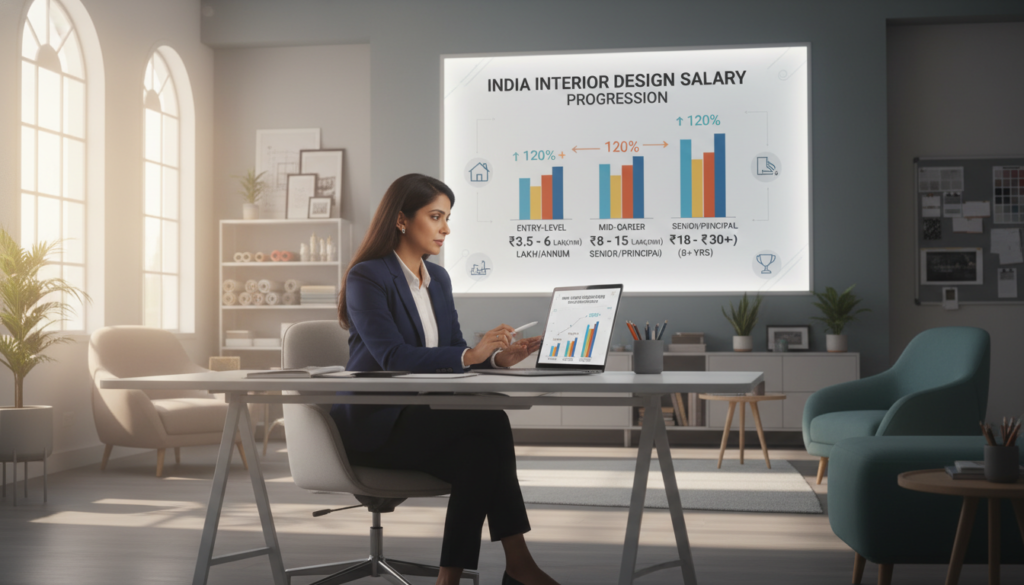
Your salary as an interior designer grows as you gain experience. Knowing how interior designer salary India increases helps you plan your career. It sets financial goals for you.
Designers with 3-5 years of experience earn between INR 6 lakhs to INR 10 lakhs annually. This shows you can manage projects and deliver quality work.
Senior designers with 7-10 years of experience earn more, from INR 12 lakhs to INR 20 lakhs or more. Top designers in big cities can earn even more, thanks to their base salary and project commissions.
Key Elements That Accelerate Your Earnings
Several factors can make your interior designer salary India grow faster. Focusing on these can boost your earnings.
Developing a signature style attracts high-end clients. This sets you apart and lets you charge more.
Building a strong reputation through successful projects creates a network of referrals. Happy clients bring you new business without marketing costs.
Focus on these key areas to grow faster:
- Expanding your professional network within the industry and among potential high-value clients
- Taking on larger, more complex projects that showcase your advanced capabilities
- Mentoring junior designers and developing leadership skills that prepare you for senior roles
- Developing business development abilities that help you generate new opportunities
- Transitioning from employee to independent consultant or firm owner when the timing is right
Each factor helps you earn more and opens doors to better opportunities. Your ability to mix design skills with business acumen affects your earnings.
Residential vs. Commercial Specialization: Financial Implications
Your choice between residential and commercial design affects your income and career. Knowing the differences helps you make informed decisions.
Commercial projects, like offices and retail spaces, offer higher fees and stable income. Corporate clients have bigger budgets and often provide ongoing work.
Commercial designers earn 20-30% more than residential designers at similar experience levels. This is because commercial projects are more complex and require business skills.
| Aspect | Residential Design | Commercial Design |
|---|---|---|
| Average Project Fee | INR 2-8 lakhs per project | INR 5-15 lakhs per project |
| Client Budget Stability | Variable, emotion-driven | Structured, business-driven |
| Project Timeline | 2-6 months typical | 4-12 months typical |
| Income Predictability | Moderate, seasonal fluctuations | Higher, corporate contracts |
Residential design can also be lucrative, focusing on high-end luxury. Working with multiple clients and building a strong network can create substantial income.
Many designers earn more by working in both residential and commercial markets. This approach provides stability while allowing creative freedom.
Your specialization should match your strengths and lifestyle. Commercial work has strict timelines and protocols, while residential projects offer more freedom and personal connections.
While financial implications are important, your long-term success depends on choosing a path that excites you. Understanding these differences helps you make strategic decisions and stay true to your design passions.
Educational Pathways and Their Impact on Salaries
Your education choices greatly affect your starting salary in design. Good training programs offer technical skills, industry connections, and practical experience. These are key to employers.
Formal education teaches design principles, software skills, and business basics. You also get hands-on experience through internships and projects. This experience helps you land better jobs and negotiate higher salaries.
Quality Training Programs
Choosing the right school is crucial for your interior design career. NIF Global Siliguri offers programs that mix theory with practical training. Their courses focus on the latest industry trends and real projects.
Students learn about design software, materials, and client management. The institute prepares you for success with experienced teachers and industry connections. To learn more, call NIF Global Siliguri at +91 98326 40060 or email nifsiliguri@gmail.com.
Professional Credentials Matter
Certifications can greatly increase your earning potential. Specialized credentials like LEED, lighting design, or software skills (Autodesk, V-Ray) can raise your value by 15-25%. They lead to more lucrative projects.
Staying updated with continuing education is vital. It keeps your skills sharp in a changing field. Those who keep learning earn more and have more job security. Your education is an investment that pays off throughout your career.